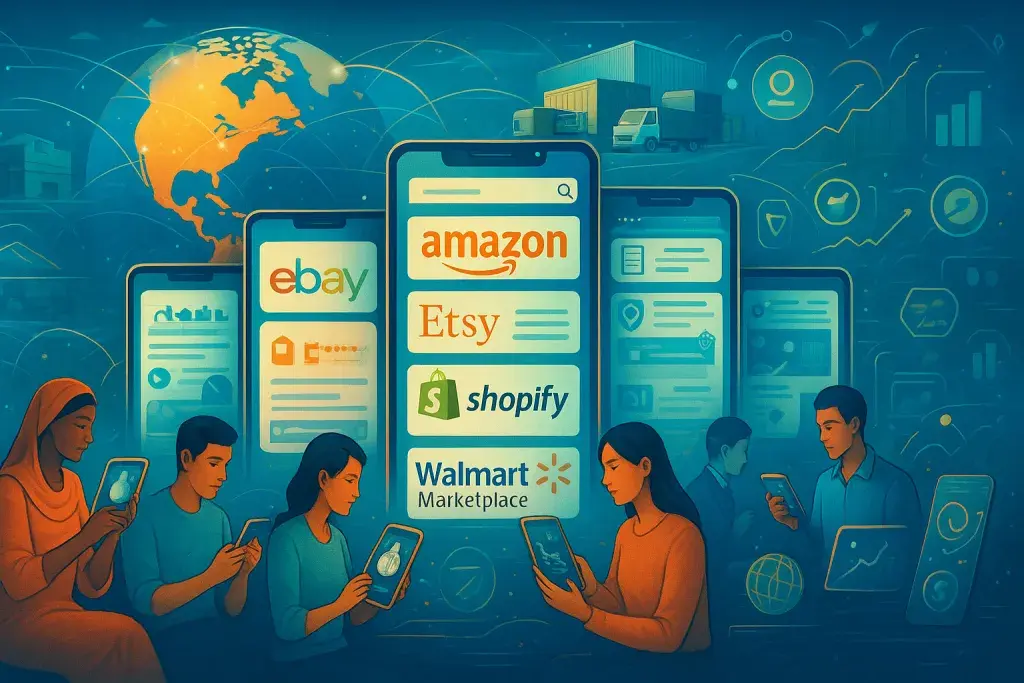
The corner store never disappeared - it multiplied into millions of virtual storefronts accessible from a phone screen. That quiet transformation, which unfolded over roughly two decades, represents one of the most consequential shifts in the history of commerce. What began as a modest experiment in selling books and collectibles online has become a global infrastructure that moves trillions of dollars in goods each year, connects buyers and sellers across continents, and forces every traditional retailer to reconsider its purpose.
Online retail now touches virtually every product category imaginable, from industrial equipment to handmade ceramics. The mechanics behind it - the platforms, algorithms, fulfillment networks, and trust systems - are complex, but the fundamental logic is straightforward: digital tools eliminate the geographic and logistical barriers that once determined who could sell to whom. Platforms like Amazon, eBay, Etsy, and Alibaba demonstrated this at scale, and resources such as access market.com reflect how broadly the concept of digital market participation has expanded beyond the largest players.
This article examines how online marketplaces and e-commerce platforms actually work, what distinguishes them from each other, and what their rise means for sellers trying to build businesses and consumers trying to shop wisely. It covers the structural mechanics, the real risks, the competitive dynamics, and the forces likely to shape the next phase of digital commerce. Whether you are entering online retail for the first time or trying to understand it more deeply, what follows offers a grounded, practical account of how this ecosystem operates.
Understanding the Foundation: What Online Marketplaces and E-Commerce Platforms Actually Are
The terms "online marketplace" and "e-commerce platform" appear constantly in conversations about digital retail, often used as if they mean the same thing. They do not - and conflating them leads to confused strategy, mismatched expectations, and poor platform choices. Before examining how these systems reshape commerce, it is worth establishing precisely what each term describes.
An online marketplace is a digital environment where multiple independent sellers list and sell products or services to buyers who visit the platform. The marketplace operator typically does not own the inventory. Instead, it provides the infrastructure - search tools, payment processing, buyer protection, and an established audience - while sellers supply the goods. Amazon Marketplace, eBay, Etsy, and Alibaba all operate on this model. The marketplace earns revenue from the transactions that flow through it; sellers earn revenue from the products they sell.
An e-commerce platform refers to the software and technical infrastructure that enables online selling. This can take the form of a standalone branded store - built on Shopify, WooCommerce, or BigCommerce - where a single merchant sells directly to customers. It can also refer to the technology layer underlying a marketplace. Some platforms serve both functions simultaneously, offering merchants the tools to build independent storefronts while also operating a multi-seller marketplace environment.
The distinctions matter practically, not just definitionally. A seller choosing between listing on a marketplace and building a standalone store is making decisions about audience access, brand control, cost structure, and long-term business strategy - not just picking a website.
| Feature | Online Marketplace | Standalone E-Commerce Platform |
|---|---|---|
| Inventory ownership | Third-party sellers | Single merchant |
| Built-in audience | Yes | No - must be acquired independently |
| Brand control | Limited | Full |
| Typical fee model | Commission per sale, listing fees | Subscription fees, per-transaction fees |
| Competitor visibility | High - rivals visible on same page | Low - own store only |
| Examples | Amazon, eBay, Etsy, Alibaba | Shopify, WooCommerce, BigCommerce |
Several distinctions deserve particular attention. On a marketplace, a seller benefits from the platform's existing traffic but competes directly against other sellers on the same product pages. On a standalone e-commerce platform, a seller controls the brand experience entirely but must invest in driving traffic independently. Neither model is universally superior - the right choice depends on product type, business goals, available resources, and how much control versus convenience a seller is willing to trade.
- Inventory ownership: Marketplaces aggregate third-party sellers; standalone platforms are operated by a single brand or merchant
- Traffic source: Marketplaces provide built-in audiences; standalone stores require the merchant to generate their own visitors
- Branding: Standalone platforms offer complete brand expression; marketplaces subordinate individual brands to the platform's identity
- Fee structures: Marketplaces charge commissions and listing fees; e-commerce platforms charge subscriptions and, in some cases, per-transaction percentages
- Customer data: Marketplace sellers typically cannot retain buyer contact details; standalone stores allow full customer relationship management
With this foundation in place, the next step is understanding how these systems have changed the people who use them most directly - the buyers.
How Digital Shopping Has Transformed Consumer Behavior and Expectations
The arrival of online retail did not simply move shopping from physical to digital. It fundamentally restructured the relationship between buyers and sellers, shifting significant power toward consumers and raising the baseline expectations that every retailer - online or offline - must now meet.
The Psychology of the Digital Shopper
Consumers who shop online arrive at purchase decisions differently than they did in physical stores. Before clicking "buy," most buyers have already consulted multiple sources - read product reviews, compared prices across platforms, watched video demonstrations, and checked social media commentary. The informed buyer is now the norm, not the exception.
This behavioral shift has compressed seller margins in competitive categories, raised quality expectations across the board, and made reputation management a core business function for any brand operating in online retail. A seller with a poor return policy or inconsistent product quality will encounter public negative reviews that persist and compound over time.
- Preference for convenience over proximity - digital shoppers regularly bypass local options in favor of broader selection and lower prices
- Price sensitivity amplified by instant comparison tools built into marketplace interfaces
- Reliance on social proof, including verified reviews, star ratings, and peer recommendations
- Low tolerance for friction - complicated checkout flows, slow-loading pages, and unclear return policies drive abandonment
- Growing expectation of personalization - shoppers expect platforms to surface products relevant to their history and preferences
The practical consequence for sellers is significant: product quality and customer experience are no longer just competitive advantages - they are survival requirements in an environment where dissatisfied buyers can make their views visible to thousands of potential customers.
The Role of Trust, Reviews, and Social Proof in Online Retail
One of the central challenges of digital shopping is that buyers cannot physically inspect products before purchasing. The sensory experience of traditional retail - touching fabric, assessing weight, examining finish quality - is absent online. Trust mechanisms have evolved to fill that gap.
Verified purchase badges, seller feedback scores, star rating aggregations, and buyer protection guarantees all serve the same function: they reduce the perceived risk of transacting with a stranger. These systems work because they are difficult to fake consistently at scale, and because platforms enforce consequences for sellers who receive persistent negative feedback.
For consumers, the practical guidance is specific: when evaluating a seller on any online marketplace, review recency matters as much as overall score. A seller with a strong historical average but declining recent ratings may have changed ownership, sourcing, or operational practices. Response behavior toward negative reviews also reveals how seriously a seller takes customer satisfaction - those who engage professionally with complaints typically deliver more reliable experiences than those who ignore or contest every negative comment.
Trust is also built at the platform level. When Amazon, eBay, or Etsy stands behind a purchase with buyer protection, that institutional guarantee extends to every seller on the platform - including new sellers with no track record. This is one of the primary reasons sellers accept marketplace fees: they are, in part, paying for borrowed trust.
Mobile Commerce and the Anywhere Economy
Smartphones transformed not just how people shop online, but when and where. Mobile commerce now accounts for the majority of e-commerce traffic globally, and the implications extend beyond screen size. Mobile shopping happens in fragmented moments - waiting rooms, lunch breaks, commutes - rather than in dedicated sessions at a desktop. This behavioral pattern has forced e-commerce platforms to redesign the entire purchase journey around speed, simplicity, and minimal friction.
Apps from major marketplace operators have reduced the number of steps between product discovery and completed purchase to the point where impulse buying is structurally encouraged. One-tap payment options, saved delivery addresses, and stored payment credentials all serve this purpose. Platforms that optimized early for mobile gained compounding advantages as mobile traffic grew, while those that treated it as a secondary channel found themselves behind in both conversion rates and search visibility within marketplace environments.
For sellers, mobile optimization is no longer optional. Product images must be clear at small sizes, titles must be readable on narrow screens, and the checkout process must function without error on both iOS and Android devices. These are table-stakes requirements, not differentiators.
Market Access Unlocked: How E-Commerce Platforms Open Global and Local Doors for Sellers
The phrase "market access" once meant something very specific: the ability to place products in stores where target customers could find them. It implied distribution agreements, wholesale relationships, retail placement fees, and often significant capital requirements. E-commerce platforms have dismantled most of those requirements, and the effects on who can participate in commerce have been profound.
How Small Sellers Gain Access to Global Audiences
Before online marketplaces existed in their current form, a small artisan, independent product creator, or niche retailer had limited paths to market. A physical storefront served a local radius. Wholesale arrangements required meeting minimum order quantities and convincing buyers to take a chance on an unknown brand. National distribution was largely inaccessible without substantial capital.
A seller on Etsy today can reach buyers across dozens of countries without a logistics department, a distribution partner, or a sales team. A small electronics reseller on Amazon can appear on the same search results page as major brands. The marketplace infrastructure - payment processing, buyer interfaces, fulfillment options, and audience aggregation - does the heavy lifting that previously required either capital or connections.
- Shared logistics and fulfillment infrastructure that sellers can access without building their own
- Built-in payment processing across multiple currencies and geographies
- Platform-provided marketing and promotional tools, including sponsored placements
- Seller analytics dashboards that reveal buyer demographics and purchasing behavior
- Translation and localization features that reduce language barriers in cross-border selling
This democratization has real limits - platforms still favor sellers who invest in advertising and those who accumulate positive reviews over time - but the baseline entry point for reaching a global audience has dropped dramatically compared to any previous era of retail.
Niche Markets and the Long Tail Effect in Online Retail
Physical retail is constrained by shelf space and local demand. A brick-and-mortar store must stock products with sufficient turnover to justify the square footage they occupy, which systematically excludes niche, specialty, or low-volume items. E-commerce platforms operate without this constraint.
Economists describe the resulting dynamic as the "long tail": the ability of digital platforms to profitably serve small audiences with specialized products that would be economically unviable in traditional retail. In aggregate, these niche offerings can match or exceed the revenue generated by mainstream bestsellers, because the audience for any specific niche product, though small in any single geographic market, is aggregated from across the globe.
Consider a seller specializing in replacement parts for vintage mechanical watches. In a single city, that market is too thin to sustain a physical storefront. Across an online marketplace with global reach, the audience is large enough to support a viable business - and the seller faces little meaningful competition because the niche is too narrow to attract large-scale operators. This pattern repeats across thousands of product categories.
For sellers, the long tail insight carries a direct strategic implication: competing on generic, high-volume product categories on major marketplaces is extraordinarily difficult. Competing on well-defined niches, where search intent is specific and competition is thinner, is often far more achievable.
Cross-Border E-Commerce and International Market Access
Cross-border selling has emerged as one of the fastest-growing segments within online retail, and the platforms enabling it have built increasingly sophisticated tools to reduce the friction that once made international commerce prohibitively complex for smaller sellers.
Currency conversion, international shipping integrations, customs documentation, import duty calculation, and local consumer protection compliance all represent genuine operational challenges in cross-border commerce. Major e-commerce platforms have developed features that address each of these, either natively or through partner integrations.
| Cross-Border Challenge | Platform Solution |
|---|---|
| Currency conversion | Multi-currency pricing and automatic conversion at checkout |
| International shipping complexity | Integrated carrier partnerships and real-time rate calculators |
| Customs and import regulations | Automated tax and duty estimation at point of sale |
| Language barriers | Automated translation of product listings and buyer communications |
| Buyer trust in foreign sellers | Platform-backed buyer protection and dispute resolution programs |
These tools do not eliminate cross-border complexity entirely. Sellers still need to understand import restrictions on specific product categories, manage longer shipping timelines, and handle returns from international buyers - all of which require planning. But the operational baseline for entering a foreign market through an established marketplace is now far lower than at any previous point in retail history.
The Mechanics Behind Online Marketplaces: How They Work and Generate Value
Understanding how online marketplaces function internally - their revenue logic, algorithmic structures, and fulfillment models - transforms how sellers and buyers interact with them. Platforms are not neutral intermediaries. They have economic incentives, and those incentives shape every policy, feature, and product decision they make.
Business Models and Revenue Structures of Major Platforms
Online marketplaces generate revenue in several distinct ways, often combining multiple models simultaneously. Understanding these structures helps sellers anticipate platform behavior and build accurate cost models before committing to a channel.
| Revenue Model | How It Works | Examples |
|---|---|---|
| Commission (referral fee) | Platform takes a percentage of each completed sale | Amazon, eBay, Etsy |
| Listing fees | Sellers pay per item listed, regardless of whether it sells | eBay in certain categories, Etsy |
| Subscription model | Sellers pay monthly or annual fees for platform access or premium tools | Amazon Professional Seller, Shopify |
| Advertising revenue | Sellers pay for promoted placements and sponsored listings | Amazon Ads, eBay Promoted Listings |
| Fulfillment services | Platform charges for warehousing, packing, and shipping on the seller's behalf | Amazon FBA, Shopify Fulfillment Network |
| Freemium with paid upgrades | Core access is free; advanced features require payment | WooCommerce, BigCommerce |
Sellers who evaluate marketplace costs by commission rate alone routinely underestimate their true cost of sale. The full stack typically includes the referral commission, fulfillment service fees if applicable, advertising spend required to maintain visibility, return processing costs, and any subscription fees. Each layer erodes margin individually; together, they can make a category that appears profitable on paper unviable in practice.
A clear warning applies here: before listing a product on any marketplace, build a complete unit economics model that accounts for every fee type the platform charges. Do this before scaling, not after discovering margin problems at volume.
Algorithms, Search Visibility, and the Competition for Discoverability
On any online marketplace, a product listing is only as valuable as its visibility. Platforms use ranking algorithms to determine which listings appear prominently in search results - and these algorithms are designed to surface products most likely to result in a completed purchase, not simply the products that have been listed longest or carry the lowest price.
Understanding the factors these algorithms weight helps sellers make decisions that improve their ranking position over time rather than working against the platform's logic.
- Sales velocity - how many units sell within a given time window
- Conversion rate - the percentage of listing visitors who complete a purchase
- Review quality and recency - both the average score and how recently reviews were submitted
- Listing completeness - thoroughness of titles, descriptions, images, and category data
- Seller performance metrics - including shipping speed, cancellation rates, and buyer communication response time
- Advertising investment - sponsored listings receive elevated placement in most marketplace environments
The compounding effect of these factors creates a significant challenge for new sellers: without sales history, conversion data, or reviews, visibility is limited. Without visibility, generating initial sales is difficult. The practical solution most experienced sellers employ is investing in advertising early, explicitly to generate the sales velocity and review accumulation that earns organic ranking over time. This is not a workaround - it is the intended path the platforms have designed.
Fulfillment Models: From Self-Shipping to Platform-Managed Logistics
Fulfillment - how a seller stores inventory, packs orders, and delivers them to buyers - is one of the most consequential operational decisions in online retail. The model a seller chooses affects cost structure, delivery speed, platform ranking, buyer satisfaction, and the amount of operational attention the business requires daily.
- Self-fulfillment (Fulfilled by Merchant): The seller manages inventory storage, order packing, and shipping entirely. This offers maximum control and avoids platform fulfillment fees, but requires operational infrastructure and limits access to premium delivery badges that influence buyer confidence.
- Platform fulfillment (e.g., Fulfilled by Amazon): The seller ships inventory to the platform's warehouses. The platform handles storage, packing, shipping, and returns. Sellers gain access to expedited delivery programs, which increase conversion, but pay storage and fulfillment fees that reduce margins.
- Third-party logistics (3PL): The seller outsources fulfillment to a specialist logistics provider, maintaining independence from any single marketplace while still offloading warehousing and shipping operations. This model suits sellers operating across multiple channels.
- Dropshipping: The seller lists products they do not own or stock. When a sale occurs, a supplier ships directly to the buyer. Startup costs are minimal, but margins are thin, and the seller bears full responsibility for a supply chain they do not control.
No single fulfillment model is optimal across all product types and business sizes. High-volume sellers of standard-size goods often benefit from platform fulfillment programs. Sellers of large, heavy, or fragile items frequently find self-fulfillment or 3PL more cost-effective. Choosing without modeling the specific costs of each option is one of the more common and expensive mistakes in early-stage online retail.
Choosing the Right Platform: Comparing Major Online Marketplaces and E-Commerce Solutions
Platform selection is a strategic decision with long-term consequences. The wrong choice - driven by familiarity, peer pressure, or incomplete information - can mean mismatched audiences, prohibitive fees, and growth ceilings that require expensive migrations to overcome. Getting it right requires a structured approach grounded in business reality, not assumption.
Major Global Online Marketplaces Compared
Different platforms serve different product categories, seller types, and buyer demographics. No single marketplace is the right answer for every seller.
| Platform | Best For | Primary Audience | Notable Advantage |
|---|---|---|---|
| Amazon | Mass-market consumer products, branded goods | Global, broad demographic range | Largest buyer base; Prime delivery ecosystem |
| eBay | Used goods, collectibles, electronics, parts | Value-focused buyers, collectors | Auction format; strong international reach |
| Etsy | Handmade, vintage, craft supplies | Creative and lifestyle-oriented buyers | Strong niche community; brand-friendlier environment |
| Alibaba / AliExpress | Wholesale, manufacturing, bulk purchasing | Global B2B and value-focused B2C | Direct access to manufacturing at scale |
| Walmart Marketplace | Established brands, everyday consumer goods | US-centric, value-oriented shoppers | Growing US alternative with established retail trust |
| Shopify | Independent brand building, direct-to-consumer | Brand-aware buyers across all demographics | Full brand control; extensive integration ecosystem |
Platform selection should begin with product-category fit. A handmade leather goods seller is likely to perform better on Etsy, where buyers arrive specifically looking for artisan products, than on Amazon, where they would compete against mass-manufactured alternatives on price. A high-volume reseller of consumer electronics fits the Amazon or Walmart Marketplace model more naturally. Mismatching product type to platform creates an uphill battle regardless of how well the seller executes everything else.
How to Choose the Right E-Commerce Platform for Your Business
Choosing a platform without a decision framework leads to decisions made on incomplete information. The following sequence provides a practical structure for making this choice deliberately.
- Define your product category clearly: Some platforms are structurally better suited to certain product types. Handmade goods, vintage items, craft supplies, and unique products belong on platforms built around that identity. Mass-produced consumer goods perform better on high-traffic general marketplaces.
- Identify where your target buyer already shops: Meeting buyers where they already spend time is more efficient than trying to attract them to a platform they do not regularly visit.
- Build a complete cost model: Include listing fees, commission rates, fulfillment costs, advertising spend, return processing, and subscription fees. Do not evaluate cost on commission rate alone.
- Assess your brand strategy: If building a recognizable brand over time is a business priority, a standalone e-commerce platform offers control that marketplaces do not. If immediate volume is the priority, marketplaces provide faster access to buyers.
- Evaluate multi-channel viability: Many successful sellers operate across several platforms simultaneously, using inventory management tools to coordinate orders centrally.
- Test before committing at scale: Start with a limited product range, measure conversion rates and margin performance, and use real data to guide expansion decisions rather than projections.
Multi-Channel Selling: Combining Marketplaces and Independent Stores
Experienced sellers in online retail rarely depend on a single channel. Multi-channel selling - maintaining a presence on one or more marketplaces while also operating an independent e-commerce store - reduces vulnerability, maximizes market access, and allows sellers to reach buyers at different stages of purchase intent.
A buyer who discovers a brand on a marketplace may later search for that brand directly, preferring to purchase from the seller's own store where prices may be lower or selection broader. Capturing both transactions requires both a marketplace presence and an independent storefront.
- Reduced exposure to algorithm changes or policy shifts on any single marketplace
- Ability to capture brand-aware buyers on an independent store while reaching new buyers through marketplaces
- Higher overall sales volume without proportionally increasing marketing investment
- Ownership of first-party customer data through the independent store, which marketplaces typically do not permit sellers to retain
The operational warning here is direct: multi-channel selling without proper inventory management systems creates serious risk. Overselling - committing the same inventory unit to multiple channels simultaneously - leads to cancellations, negative reviews, and damaged seller metrics on every affected platform. Scaling across channels without synchronization tools in place is one of the more avoidable but common operational failures in online retail growth.
Challenges, Risks, and Common Mistakes in Digital Shopping and Online Retail
The opportunity in online retail is genuine, but it exists alongside real and sometimes underestimated risks. For sellers, some of those risks can threaten a business entirely. For consumers, others can result in financial loss or persistent frustration. Understanding them is not pessimistic - it is necessary for operating intelligently in this environment.
Risks and Challenges for Sellers in Online Marketplaces
Sellers who build their entire business on a single marketplace often do not recognize the structural vulnerability of that position until something goes wrong. Marketplace operators hold significant power over the sellers who depend on them - and that power is exercised through account policies, fee structures, and algorithm changes that sellers have no meaningful ability to negotiate.
- Account suspension: Platforms can suspend or permanently close seller accounts for policy violations, sometimes based on automated systems that flag listings incorrectly. For sellers with no alternative channel, a suspension eliminates all revenue immediately.
- Listing hijacking and counterfeiting: On large marketplaces, unauthorized sellers can attach themselves to a legitimate seller's product listing, often offering counterfeit versions at lower prices. This harms both the original seller and buyers who receive inferior products.
- Fee increases and policy changes: Marketplace operators revise their fee structures and operational requirements regularly. Sellers have no negotiating power and must either absorb increased costs or exit the platform.
- Price erosion in competitive categories: The visibility of competitor pricing on marketplaces drives race-to-the-bottom dynamics in categories with many similar sellers, compressing margins progressively over time.
- Customer data restrictions: Most marketplaces prohibit sellers from using buyer contact information for direct marketing, limiting the ability to build lasting customer relationships outside the platform.
Consumer Risks and How to Shop Safely in Digital Marketplaces
For buyers, the convenience of digital shopping does not come without risk. On platforms where third-party sellers operate alongside the marketplace itself, quality control is inherently distributed - and buyers bear the primary responsibility for evaluating seller credibility before purchasing.
- Counterfeit or materially misrepresented products, particularly in categories like electronics, cosmetics, and branded apparel
- Fraudulent seller accounts that collect payment and disappear before fulfilling orders
- Misleading or manufactured reviews that distort actual product quality signals
- Privacy exposure through unsecured payment pages or phishing communications impersonating legitimate platforms
- Difficult or impossible returns from sellers based in foreign jurisdictions
Practical protective steps for buyers are straightforward:
- Purchase from sellers with established review histories - look at review volume, recency, and the seller's response to negative feedback
- Use credit cards or platform-provided payment systems that include buyer protection and chargeback rights
- Read the return and refund policy in full before purchasing, particularly from international sellers
- Treat prices dramatically below market value as a warning signal, not an opportunity - they frequently indicate counterfeit or fraudulent listings
- Check for review authenticity by looking at reviewer account age, number of reviews submitted, and whether the review content is specific or suspiciously generic
The Counterfeiting Problem and Platform Accountability
Counterfeiting in online retail is a persistent, large-scale problem that major marketplaces have invested significantly in addressing - without fully solving. The challenge is structural: platforms that enable millions of sellers to list products cannot manually verify every listing, and counterfeiters adapt quickly to enforcement measures.
Major marketplace operators have developed brand protection programs in response. Amazon's Brand Registry, Alibaba's intellectual property protection portal, and eBay's Verified Rights Owner program all give brand owners formal channels to report and request removal of infringing listings. These tools provide a mechanism for enforcement, but the responsibility for monitoring and submitting reports largely falls on the brand owner - a continuous burden that smaller companies often lack the resources to manage consistently.
Buyers can reduce their exposure by purchasing directly from brand-verified storefronts when they exist on a platform, checking that the seller name matches the brand they expect, and remaining skeptical of product packaging or branding that appears slightly off in listing photographs. None of these measures are foolproof, but they reduce risk meaningfully.
The Future of Online Marketplaces and E-Commerce: Trends Reshaping Digital Retail
Online retail as it exists today reflects the accumulated decisions, technologies, and behaviors of roughly two decades of development. The next phase is already visible in the form of several converging trends that will alter how platforms operate, how sellers compete, and how consumers experience digital shopping.
Artificial Intelligence, Personalization, and Predictive Commerce
Artificial intelligence has been present in e-commerce platforms for years in the form of recommendation engines, fraud detection systems, and dynamic pricing tools. The shift underway now is a move from reactive AI - responding to what a user has already done - toward predictive AI that anticipates behavior before it occurs.
Predictive commerce involves systems that surface products a consumer is likely to want based on behavioral patterns, seasonal signals, purchase history, and real-time contextual data. At its most developed, this means a platform that begins curating a buyer's next purchase before the buyer has consciously decided they need anything.
- Dynamic pricing engines that adjust product prices in real time based on demand, inventory levels, and competitor pricing
- Visual search tools that allow buyers to find products by uploading images rather than describing them in text
- AI-driven fraud detection that identifies suspicious seller and buyer behavior patterns before they cause harm
- Automated customer service systems capable of resolving common post-purchase issues without human intervention
- Individualized homepage and search experiences that change based on each user's behavior history
For sellers, the implication is that product data quality - accurate titles, complete specifications, high-resolution images, thorough descriptions - becomes increasingly important as AI systems rely on structured listing data to determine relevance and placement.
Social Commerce and the Integration of Shopping into Social Media
Social media platforms have evolved from discovery channels that drive traffic to e-commerce destinations into transactional environments in their own right. TikTok Shop, Instagram Shopping, Pinterest's buyable pins, and Facebook Marketplace all represent the convergence of social engagement and purchase completion into a single experience.
This integration has significant implications for how brands think about their digital retail presence. When a buyer can move from watching a product demonstration to completing a purchase without leaving the social application, the traditional funnel - awareness, consideration, decision, purchase - collapses into a single moment. Platforms optimized for this behavior experience higher impulse purchase rates and shorter decision cycles.
For sellers whose target buyers are concentrated on social platforms, building a presence in social commerce environments is increasingly a primary strategy rather than a supplementary one. For platforms, social commerce represents a new revenue stream and a competitive threat from social networks that are building commerce capabilities rapidly.
Sustainability, Ethical Commerce, and Consumer Expectations
Sustainability has moved from a marketing angle to a genuine purchasing criterion for a growing segment of consumers, particularly younger buyers. E-commerce platforms have responded by developing certification programs, product filters, and environmental commitments that help buyers identify products aligned with their values.
Several major marketplace operators now offer sustainability-focused product certifications that appear on qualifying listings, making it easier for buyers to filter search results by environmental or ethical criteria. These features are not purely value-driven - they respond to demonstrated consumer demand and serve a competitive differentiation function for platforms in markets where buyers have multiple channel options.
For sellers, the practical implication is that authentically sustainable products and practices, communicated credibly through listing content and brand storytelling, carry increasing commercial value. Claims that cannot be substantiated, however, carry growing legal and reputational risk as regulatory scrutiny of environmental marketing increases across major markets.
Questions and Answers
If I sell on a marketplace, can the platform change my fees or remove my listings without notice?
Yes, and this happens with some regularity. Marketplace operators treat fee structures and listing policies as internal operational decisions they can revise unilaterally. Most seller agreements explicitly reserve this right. Sellers are typically notified in advance of changes, but the notice period and recourse options are limited. Building redundancy - operating on more than one channel - is the most effective protection against the business impact of sudden platform changes.
What is the actual cost difference between selling on a marketplace versus running my own e-commerce store?
Marketplace selling typically costs 10-20% of gross revenue when commissions, fulfillment fees, and advertising are combined, though this varies significantly by platform and category. A standalone e-commerce store shifts costs toward customer acquisition - advertising, content, and email marketing - which can be higher per customer initially but does not scale linearly with revenue the way commissions do. The right answer depends on your volume, margins, and whether you have an existing audience or must build one from scratch.
How do marketplace algorithms decide which products appear first in search results?
Marketplace algorithms generally prioritize listings most likely to result in a completed purchase, not those that have been listed longest or carry the lowest price. Sales velocity, conversion rate, review quality, listing completeness, and advertising spend all influence ranking. A new listing with no sales history starts at a structural disadvantage, which is why most experienced sellers invest in paid placement early to generate the performance data that earns organic visibility over time.
Is dropshipping a viable business model on major online marketplaces?
Dropshipping is viable but carries specific risks that many beginners underestimate. Because the seller does not control inventory or fulfillment, any supplier error - late shipment, wrong item, quality problem - becomes the seller's customer service problem and affects the seller's platform performance metrics. Margins are typically thin because the supplier absorbs the fulfillment cost before passing the remainder to the seller. Dropshipping works best as a low-cost product-testing method, not as a long-term scalable model, unless supported by reliable, vetted supplier relationships.
How can a buyer tell whether reviews on a marketplace listing are genuine?
Genuine reviews tend to be specific - they describe actual product use, mention particular features, and reflect both positives and negatives. Suspicious patterns include large clusters of five-star reviews submitted within a short period, reviewer accounts with only one or two total reviews, and review text that is vague, overly enthusiastic, and nearly identical across multiple listings. Checking the most recent reviews, sorted by date rather than helpfulness, often provides a more accurate picture of current product and seller quality than the aggregated rating alone.
What does cross-border e-commerce actually require from a small seller getting started?
At minimum, a seller needs to understand import restrictions on their specific product category in target markets, configure their listings with accurate country-of-origin and customs information, offer shipping options that realistically serve international delivery timelines, and establish a clear returns policy that accounts for the cost and complexity of international returns. Many marketplace platforms automate tax and duty calculations at checkout, which removes one major complexity. Starting with one or two international markets rather than opening globally from day one allows a seller to learn the operational requirements without being overwhelmed.