
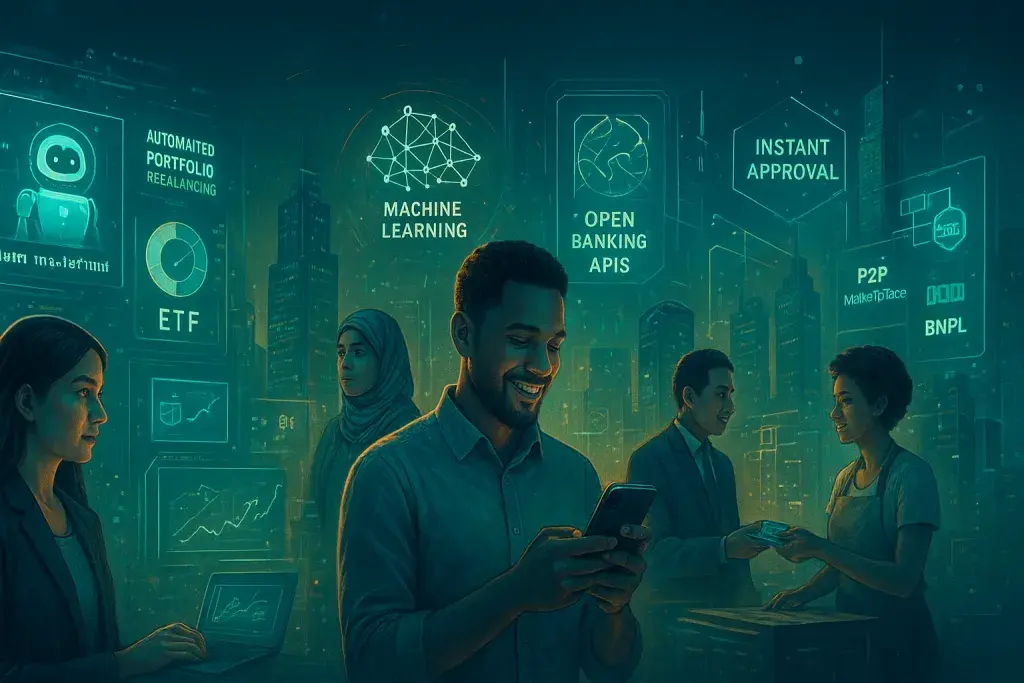
The last institution most people expected to be disrupted by software was the bank. For centuries, financial intermediaries thrived on information asymmetry, regulatory moats, and the sheer complexity of moving money. Then, in the span of roughly fifteen years, a combination of mobile computing, cloud infrastructure, open data standards, and machine learning began dissolving those advantages one by one. The result is a financial services sector that looks structurally different from anything that existed before 2010 - and the transformation is still accelerating.
What makes the current wave of fintech innovations distinctive is not just the technology itself, but the depth of its penetration. Earlier generations of financial technology - ATMs, electronic trading, online banking - automated existing processes. What is happening now goes further: it is rewriting the logic of how credit is assessed, how portfolios are managed, and who gets access to financial products at all. The scale of capital flowing into this space reflects that ambition. Thousands of fintech companies now operate across every segment of financial services, from consumer credit to institutional asset management, from insurance to cross-border payments.
This article examines the three areas where that transformation is most concrete and consequential: asset management trends driven by artificial intelligence and automation, the evolution of credit scoring analytics beyond traditional bureau-based models, and the rise of digital lending platforms that are restructuring how credit reaches individuals and businesses. The goal is not to survey every fintech development, but to explain the ones that are actually changing the underlying mechanics of finance.
1. The Fintech Revolution: Redefining the Financial Services Sector
1.1 From Disruption to Integration: How Fintech Evolved
The early narrative around fintech was adversarial. Startups would disintermediate banks the way streaming services disrupted cable. That framing captured something real about the ambition of early fintech entrepreneurs, but it badly misread how incumbent financial institutions would respond - and how regulators would shape the playing field.
The 2008 financial crisis created the conditions for fintech's emergence in two ways. It damaged consumer trust in traditional banks at precisely the moment smartphones were becoming powerful enough to replace them as interfaces for financial services. Between 2010 and 2015, a generation of challenger banks, payment processors, and peer-to-peer lenders built entirely new user experiences on top of - or entirely outside - existing banking infrastructure.
By the late 2010s, however, the disruption story had given way to something more nuanced. Large banks responded not primarily by losing market share, but by acquiring fintech companies, building internal innovation labs, and entering partnership agreements with the very startups that had threatened them. Today, the fintech innovations most consumers encounter daily - instant bank transfers, digital mortgage applications, algorithmic credit offers - are frequently delivered through a hybrid model in which a traditional institution's balance sheet and regulatory license powers a fintech company's technology and user experience.
- The API economy enabled fintechs to build on top of banking infrastructure rather than rebuilding it from scratch
- Embedded finance moved fintech capabilities into non-financial apps, from ride-sharing to e-commerce platforms
- Regulatory sandboxes in the UK, Singapore, and other markets allowed controlled experimentation that accelerated legitimate innovation
- Acquisitions by major institutions - rather than displacement - became the dominant exit path for many fintech ventures
The picture today is one of deep integration rather than clean disruption. Fintech is less a separate industry competing with finance than it is a set of capabilities embedded throughout the financial services sector.
1.2 The Scale of Change: Key Statistics and Market Context
Gauging the actual scale of fintech's impact requires looking beyond headlines. The global fintech market has grown substantially across every major region, driven by smartphone penetration, the shift to digital payments accelerated by the pandemic, and sustained institutional investment in financial technology infrastructure.
Asia-Pacific - led by China and India - has produced some of the world's largest fintech ecosystems by user volume, with mobile payment platforms that now handle transactions at a scale dwarfing most Western equivalents. North America remains the center of institutional fintech investment, particularly in lending and wealth management technology. Europe's Open Banking framework under PSD2 has made it a testing ground for data-driven financial services that other regions are now beginning to replicate.
| Region | Primary Growth Driver | Key Fintech Segments | Regulatory Framework |
|---|---|---|---|
| North America | Institutional investment, digital lending | Lending platforms, wealthtech, insurtech | SEC oversight, state lending licenses, CFPB |
| Europe | Open Banking mandates (PSD2) | Payments, neobanks, credit analytics | PSD2, GDPR, national financial regulators |
| Asia-Pacific | Mobile penetration, underbanked population | Mobile payments, microlending, digital banking | Variable by country; MAS (Singapore) is notable |
| Latin America | Financial inclusion, high unbanked rates | Digital payments, consumer lending, remittances | Emerging frameworks; Brazil's Open Finance leads |
| Africa | Mobile money infrastructure | Mobile wallets, SME lending, agent banking | Fragmented; Kenya, Nigeria are regional leaders |
What these regional differences share is a common underlying dynamic: technology is making it economically viable to serve financial customers who were previously too expensive to reach. That logic applies whether the customer is a rural smallholder in Kenya using a mobile wallet or a young professional in Berlin managing investments through a robo-advisor. The cost economics of digital financial services have fundamentally changed what is possible.
2. Fintech Innovations in Asset Management: Smarter, Faster, More Accessible
2.1 Robo-Advisors and Algorithm-Driven Portfolio Management
Robo-advisors represent the most visible consumer-facing application of fintech in investment management. The core proposition is straightforward: replace the human financial advisor - whose economic model requires clients with substantial assets to be profitable - with an automated system that can serve any account size at minimal cost.
A robo-advisor typically begins by collecting a risk profile through a structured questionnaire covering investment horizon, income, financial goals, and tolerance for loss. It then allocates the client's capital across a diversified portfolio of low-cost index funds or exchange-traded funds, rebalancing automatically as markets move and harvesting tax losses where applicable. The entire process runs without human intervention.
The fee comparison with traditional wealth management is stark. Where a traditional financial advisor might charge 1% or more of assets under management annually, robo-advisors typically charge between 0.25% and 0.50%, with some offering basic services at no annual fee. For accounts below roughly $250,000 - the range where most retail investors operate - this difference compounds significantly over time.
| Platform Type | Typical Minimum Investment | Approximate Annual Fee | Key Features | Best Suited For |
|---|---|---|---|---|
| Pure robo-advisor | Low or none | 0.25%-0.50% | Automated rebalancing, tax-loss harvesting | Cost-conscious retail investors |
| Hybrid robo-advisor | Moderate | 0.50%-0.85% | Algorithm-driven with optional human advisor access | Investors wanting occasional guidance |
| Traditional wealth manager | High (often $250,000+) | 1.00%-1.50%+ | Comprehensive planning, human relationship | High-net-worth, complex financial situations |
| Digital direct indexing | Moderate to high | 0.20%-0.40% | Personalized index portfolios, tax optimization | Tax-sensitive investors with larger portfolios |
The limitations of robo-advisors are real and worth stating plainly. Purely algorithmic systems struggle in periods of genuine market stress, when behavioral guidance - the kind a skilled human advisor provides to prevent panic selling - matters most. They also handle poorly the complexity of integrated financial planning: estate considerations, business ownership, tax-specific circumstances that require judgment rather than optimization. The hybrid model, which pairs algorithmic portfolio management with on-demand human advice, has emerged partly in response to these gaps and now represents a significant portion of assets managed under this category of asset management trends.
2.2 AI and Machine Learning in Institutional Asset Management
The application of artificial intelligence in institutional asset management operates at a different level of sophistication than consumer robo-advisors, and has been developing for longer than most public coverage suggests. Quantitative hedge funds began using systematic, model-driven strategies decades ago. What has changed is the availability of non-traditional data, the computational power to process it, and the maturity of machine learning techniques that can extract signal from sources that earlier statistical models could not handle.
Natural language processing now allows asset managers to analyze earnings call transcripts, regulatory filings, news feeds, and social media commentary at a scale no human analyst team could match. The output feeds into sentiment models that inform short-term trading signals or longer-term fundamental assessments. Separately, machine learning models are used in factor investing to identify which combinations of financial characteristics have historically been associated with outperformance - and to detect when those relationships are changing.
BlackRock's Aladdin platform, which processes risk analytics for trillions of dollars in assets, represents one well-documented example of how deep technology infrastructure has become in institutional asset management. Man Group's AHL division is widely known for its systematic, machine-learning-driven trading strategies. These are not peripheral experiments - they are the operational core of some of the world's largest investment organizations.
- Sentiment analysis of earnings calls, news, and filings to supplement fundamental research
- Alternative data inputs including satellite imagery, shipping data, and consumer transaction patterns
- Machine learning applied to factor discovery and portfolio construction optimization
- AI-driven scenario analysis and stress testing for risk management
The challenges are genuine. Machine learning models trained on historical data can overfit patterns that no longer hold. The more firms use similar models, the more they may crowd into the same positions, amplifying volatility rather than dampening it. And regulators are increasingly asking institutions to explain how algorithmic decisions are made - a requirement that sits in uncomfortable tension with the complexity of many machine learning architectures.
2.3 Tokenization and Blockchain in Asset Management
Asset tokenization involves representing ownership of a real-world asset - real estate, private equity, infrastructure, art - as a digital token on a blockchain. The token can then be transferred, subdivided, or traded with the same efficiency as a cryptocurrency, while representing a claim on something tangible and legally defined.
The potential benefit is significant for asset classes that have historically been illiquid and inaccessible to most investors. A commercial real estate portfolio worth hundreds of millions of dollars could theoretically be divided into thousands of tokens, allowing investors to participate with much smaller capital commitments. Secondary trading of those tokens could provide liquidity that simply does not exist in traditional private markets.
Practical implementation has proven more complex than early proponents suggested. Legal frameworks for token ownership vary substantially across jurisdictions. Custody arrangements for tokenized assets require new infrastructure. And the question of what happens when smart contract logic conflicts with real-world legal obligations has not been resolved in most markets. Progress is occurring - several large financial institutions have conducted tokenized bond issuances, and tokenized money market funds have been tested in regulated environments - but widespread adoption of tokenization in asset management remains a medium-term development rather than an immediate reality.
3. Transforming Credit Scoring Analytics: Beyond the FICO Score
3.1 The Limitations of Traditional Credit Scoring
The three-digit credit score is one of the most consequential numbers in modern economic life, yet it is built on a remarkably narrow foundation. Traditional bureau-based scores - of which the FICO score is the dominant example in the United States - are calculated primarily from credit account history: payment behavior on loans and credit cards, outstanding balances relative to credit limits, length of credit history, and the mix of credit types held.
This works reasonably well for people who have spent years using credit products. It works poorly for everyone else. An estimated 45 million Americans have either no credit file or one too thin to generate a reliable score - a population that includes recent immigrants, young adults, people recovering from financial disruption, and many who simply prefer to manage their finances without credit cards. Internationally, the proportion of adults without a usable credit history is far higher.
The backward-looking nature of traditional scoring compounds this problem. A score reflects credit behavior from the past - often years in the past - and tells lenders relatively little about a borrower's current financial health. Someone whose income has recently increased substantially, whose expenses have fallen, or who has accumulated savings may look identical to someone in financial distress if their credit account activity has not changed. Traditional credit scoring analytics capture the record of past debt behavior, not the reality of present financial capacity.
There is also documented evidence that traditional scoring models produce disparate outcomes across demographic groups, not because they are designed to discriminate, but because historical patterns of credit access and usage are themselves shaped by factors including income inequality and historical lending discrimination. The score reflects reality accurately in one sense and perpetuates inequality in another.
3.2 Alternative Data and Machine Learning in Credit Assessment
The response from fintech lenders has been to expand the data inputs for credit decisions far beyond what traditional bureaus collect. Alternative data for credit assessment falls into several broad categories, each carrying different predictive value and regulatory implications.
Cash flow analysis - examining actual income and spending patterns through access to bank transaction data - is among the most practically powerful alternatives. A lender who can see twelve months of deposit and withdrawal history gains a substantially richer picture of financial behavior than any credit score provides. Rental and utility payment history can demonstrate consistent financial responsibility in people who have never held a credit card. In some markets, telecom payment data serves a similar function.
Machine learning models, particularly gradient boosting algorithms, are well-suited to integrating these heterogeneous data sources into a unified creditworthiness assessment. They can identify non-linear relationships between variables that traditional logistic regression models miss. Upstart, a US-based lending platform, has published analysis suggesting its models approve a higher proportion of applicants than traditional models while maintaining comparable default rates - a combination that implies either better risk identification or more efficient pricing, or both.
| Dimension | Traditional Credit Scoring | Alternative Data Credit Scoring |
|---|---|---|
| Primary data sources | Credit bureau files (loans, cards, payment history) | Bank transactions, rent, utilities, employment, behavioral data |
| Model type | Scorecard / logistic regression | Machine learning (gradient boosting, neural networks) |
| Population coverage | Excludes thin-file and no-file consumers | Can assess credit-invisible borrowers |
| Decision speed | Minutes to days | Seconds to minutes |
| Regulatory scrutiny | Well-established compliance frameworks | Evolving; explainability requirements under development |
| Inclusion outcomes | Systematically excludes large populations | Potential to extend credit access substantially |
Tala, a mobile lending platform operating in East Africa and Southeast Asia, uses smartphone data - app usage patterns, communication frequency, geographic consistency - to build credit profiles for populations with no formal financial history. The model has extended credit to millions of borrowers who would be invisible to any traditional bureau. This kind of approach represents credit scoring analytics at its most consequential: determining financial inclusion for people at the economic margins.
3.3 Regulatory Challenges and Ethical Considerations in AI-Driven Scoring
More powerful credit scoring models create a new class of problems that are distinct from those associated with traditional scoring. The core tension is between predictive accuracy and explainability. A gradient boosting model trained on hundreds of variables can outperform a traditional scorecard on virtually every statistical measure, but it cannot easily tell a rejected applicant why they were turned down - or tell a regulator whether the model systematically disadvantages protected groups.
In the United States, the Equal Credit Opportunity Act requires lenders to provide specific, principal reasons for adverse credit decisions. That requirement was written for logistic regression models where coefficients are interpretable. Applying it to a complex machine learning model requires significant additional engineering - so-called explainability layers - that translate the model's outputs into human-readable reason codes without necessarily capturing what the model actually did.
GDPR in the European Union adds another layer: individuals have the right not to be subject to purely automated decisions that significantly affect them, and the right to a meaningful explanation when such decisions are made. These requirements are reshaping how European fintech lenders architect their credit decision systems.
The risk of encoding new forms of bias through alternative data is not hypothetical. If certain app usage patterns, behavioral signals, or geographic data correlate with race or national origin - even without explicitly including those variables - a model can produce discriminatory outcomes while appearing technically neutral. Responsible lenders must conduct disparate impact testing as a routine part of model governance, not as an afterthought.
- Build model explainability into the architecture from the start, not as a retrofit
- Conduct regular disparate impact analysis across demographic groups
- Maintain human override mechanisms for borderline decisions
- Document model development, validation, and monitoring processes for regulatory review
- Engage legal and compliance teams early when introducing new data sources
4. Digital Lending Platforms: Speed, Access, and the New Credit Infrastructure
4.1 How Modern Digital Lending Platforms Work
The operational difference between a traditional bank loan and a digital lending platform decision is not merely a matter of speed - it reflects a fundamentally different architecture for how credit is originated, underwritten, and serviced. Understanding that architecture clarifies why fintech lenders can approve a personal loan in minutes when a bank might take days or weeks for an equivalent application.
- Digital application and identity verification: The borrower completes an application through a web or mobile interface. Identity is verified electronically through document scanning, database checks, and liveness detection, replacing branch-based ID verification.
- Automated data aggregation: With the applicant's consent, the platform pulls bank transaction history through open banking APIs, payroll data through employer connectivity services, and tax records or other financial documentation electronically.
- Real-time credit decisioning: Machine learning models process the aggregated data - including bureau data where available - and generate a credit decision, typically within seconds of data receipt.
- Dynamic pricing and offer generation: Rather than offering a single loan product, the platform generates an offer tailored to the applicant's specific risk profile, including rate, term, and amount options.
- Electronic contract execution: The borrower reviews and electronically signs loan documents. No paper, no branch visit, no manual processing.
- Automated servicing: Repayments are collected via direct debit. Delinquency is flagged algorithmically and triggers automated communication workflows before human intervention is required.
| Stage | Technology Used | Typical Time (Digital) | Traditional Equivalent |
|---|---|---|---|
| Application | Mobile/web interface, digital forms | 5-10 minutes | Branch visit or paper form |
| Identity verification | Document OCR, biometric liveness | Under 2 minutes | Manual ID check, 1-2 days |
| Data aggregation | Open banking APIs, payroll connectors | Seconds to minutes | Manual document submission, 3-5 days |
| Credit decision | ML scoring models | Seconds | Underwriter review, 1-5 days |
| Contract execution | E-signature platforms | Minutes | Paper signing, branch or mail |
| Fund disbursement | Real-time payment rails | Same day or instant | 1-3 business days |
The economic logic of this architecture is as important as its operational speed. By replacing labor-intensive manual processes with automated systems, digital lending platforms reduce origination costs substantially. That reduction allows them to price competitively, extend credit to borrower segments that were previously uneconomical to serve, or both.
4.2 Peer-to-Peer and Marketplace Lending Models
Peer-to-peer lending platforms, which emerged prominently in the mid-2000s, introduced a structurally different credit intermediation model. Rather than a bank taking deposits and making loans using its own balance sheet, P2P platforms matched individual borrowers with individual or institutional investors willing to fund those loans, charging a fee for origination and servicing.
The distinction between pure P2P and marketplace lending matters: pure P2P involves retail investors directly funding individual loans, while marketplace lending has evolved toward institutional capital - hedge funds, insurance companies, and banks - as the primary funding source. LendingClub, Funding Circle, and Prosper are among the platforms that pioneered this model in the US and UK.
The early P2P model encountered meaningful difficulties that the industry has since worked to address. Retail investor concentration in any single borrower creates idiosyncratic risk that most individuals are poorly equipped to manage. During periods of economic stress, default rates on unsecured consumer loans can spike in ways that surprise investors who were attracted primarily by the headline yields. Several platforms also faced operational and governance challenges unrelated to credit performance.
The evolution toward institutional funding has made the model more stable but has also diluted its original democratizing proposition. Today's marketplace lending platforms function more like technology-enabled loan originators that distribute risk to sophisticated capital providers, with retail investors often accessing the asset class indirectly through funds or securitizations rather than directly.
4.3 Embedded Finance and Buy Now Pay Later: Credit at the Point of Sale
Embedded finance describes the integration of credit, payments, and other financial services directly into non-financial consumer experiences. A consumer buying electronics online who is offered an installment plan at the checkout is experiencing embedded credit. A small business owner who receives a working capital offer inside their accounting software is encountering embedded lending. The financial product appears at the moment of need, inside the context where the need arises, without requiring the consumer to visit a separate financial institution.
Buy now pay later represents the highest-profile expression of this trend. BNPL services - offered by companies including Klarna, Affirm, and Afterpay - allow consumers to split purchases into a small number of interest-free installments, with the retailer subsidizing the cost in exchange for higher conversion rates and larger average order values. The proposition spread rapidly through e-commerce and, more recently, into in-store retail and services.
The consumer risk concerns around BNPL are legitimate and worth examining directly. Unlike traditional credit cards, most BNPL products do not report repayment behavior to credit bureaus, meaning that both responsible repayment and missed payments may be invisible to the broader credit system. A consumer can hold multiple simultaneous BNPL obligations across different platforms without any single lender seeing the full picture. Regulatory responses have accelerated: the UK, Australia, and the European Union have all moved toward bringing BNPL under consumer credit regulations that require affordability assessments and clear disclosure of terms.
- BNPL has genuinely expanded purchasing power for many consumers managing cash flow within a pay period
- The absence of credit bureau reporting creates an invisible debt stack that underwriting models cannot see
- Merchants subsidize BNPL costs because conversion and basket size improvements justify the fee
- Regulatory tightening is underway in most major markets, likely increasing compliance costs for providers
- BNPL is expanding beyond retail into healthcare, education, and travel
4.4 Small Business and SME Lending: Filling the Gap Left by Banks
Small and medium enterprises have historically faced a structural disadvantage when seeking credit from traditional banks. The cost of underwriting a small business loan - which requires reviewing business financials, assessing industry risk, and evaluating management - is not dramatically lower than underwriting a larger commercial loan, but the interest income is proportionally far less. Banks have responded to this economic reality by setting minimum loan sizes and document requirements that effectively exclude many small businesses from accessing credit at all.
Fintech lending platforms have addressed this gap through a combination of automated underwriting and alternative data. Revenue-based financing platforms assess creditworthiness primarily through transaction data - the volume, consistency, and growth pattern of business receipts flowing through a payment processor or bank account - rather than through audited financial statements that small businesses often cannot produce.
Platforms such as Kabbage, OnDeck, Fundbox, and iwoca built their models on exactly this premise: connect to a business's accounting software or bank data, analyze cash flow patterns, and generate a credit offer in minutes. The trade-off is cost - interest rates and fees on short-term SME fintech loans are generally higher than equivalent bank products - but for many small businesses, speed and accessibility matter more than rate optimization.
Open banking has meaningfully improved the accuracy of SME credit assessment by providing lenders with real-time, standardized access to business banking data. A lender who can see actual cash flow in near-real-time is better positioned to make a reliable lending decision than one relying on three-month-old bank statements provided by the applicant. This data quality improvement is gradually reducing the risk premium embedded in SME fintech lending rates.
5. Open Banking and Data Infrastructure: The Backbone of Fintech Innovation
5.1 What Open Banking Enables and How It Works
Open banking is the regulatory and technical framework that allows consumers and businesses to share their financial data with authorized third parties through standardized application programming interfaces. The fundamental shift it represents is one of data ownership: historically, financial data sat inside banks and was accessible only to those banks. Open banking transfers effective control of that data to the account holder, who can then grant access to any authorized service.
In the European Union and UK, PSD2 (the revised Payment Services Directive) mandated that banks build and maintain open APIs for qualified third parties from 2018 onward. Australia implemented a similar framework through the Consumer Data Right. The United States has been moving toward open banking through a combination of market-driven development and regulatory guidance from the Consumer Financial Protection Bureau. Other markets are at various stages of framework development.
The practical applications enabled by open banking infrastructure are broad. Credit assessments can use real transaction data rather than imputed estimates. Personal financial management applications can aggregate accounts across multiple institutions. Payment initiation services can move money directly from bank accounts without requiring a payment card network. Each of these capabilities depends on the same underlying infrastructure: reliable, standardized, consented data access.
- Account information services: read-only access to transaction history for analysis and aggregation
- Payment initiation services: ability to trigger payments directly from a user's bank account
- Variable recurring payments: programmable payment mandates for subscription and utility billing
- Confirmation of payee: real-time verification that a recipient account matches the expected name
Consumer consent management is the critical governance element in any open banking system. A consumer must explicitly authorize each data sharing arrangement, specify what data can be accessed and for how long, and be able to revoke access at any time. When these controls are implemented well, open banking is privacy-preserving by design. When they are implemented poorly - with pre-ticked consent boxes or buried terms - they create exactly the kind of opacity that financial regulators are designed to prevent.
5.2 Data Aggregation Platforms and Their Role in the Fintech Ecosystem
Between banks and the fintech applications that consume financial data sits a layer of infrastructure that most consumers never see: data aggregation platforms. Companies like Plaid, Tink, and MX connect to thousands of financial institutions, normalize the data formats that vary from bank to bank, and deliver a standardized data feed to the applications built on top of them. A consumer who links their bank account inside a budgeting app, a lending platform, or a tax software product is almost certainly passing through one of these aggregators.
The business model is straightforward: aggregators charge the applications and fintech platforms that use their services, either per connection or per data pull. Their value is in scale and reliability - a fintech company that wants to access data from hundreds of banks does not need to build and maintain individual integrations with each; it connects once to an aggregator and inherits the full network.
The concentration this creates is a genuine concern for the broader ecosystem. A small number of aggregators handle a very large proportion of financial data flows across the fintech industry. An outage at a major aggregator can simultaneously affect hundreds of applications. A data breach at an aggregator touches data from millions of accounts across thousands of institutions simultaneously. Regulators and competition authorities in several markets have scrutinized this concentration.
A secondary tension exists between aggregators that operate through direct API access - the model mandated by open banking frameworks - and those that still use screen scraping, which involves collecting data by simulating a user login to a bank's website. Screen scraping is less reliable, raises security concerns, and is being phased out in markets where open banking APIs are mature, but remains in use where API coverage is incomplete.
6. Risks, Challenges, and the Road Ahead for Fintech in Financial Services
6.1 Cybersecurity, Fraud, and Systemic Risk
The digitization of lending, asset management, and credit assessment creates attack surfaces that did not exist in paper-based financial systems. Every API connection, every automated data pull, every digital identity verification creates a potential entry point for adversarial actors. Cybersecurity is not a peripheral concern for fintech platforms - it is a core operational requirement.
Synthetic identity fraud deserves particular attention in the context of digital lending platforms. Unlike traditional identity theft, which involves stealing and using an existing person's credentials, synthetic fraud involves constructing a false identity from a combination of real and fabricated information. These synthetic identities can be built over time - establishing a thin credit file, demonstrating payment behavior - before the perpetrator rapidly draws down credit across multiple lenders. The fully automated underwriting processes that make digital lending fast also make it potentially vulnerable to sophisticated synthetic fraud at scale.
Systemic risk is a less visible but structurally important concern. When a large proportion of the fintech industry relies on the same data aggregators, cloud infrastructure providers, or payment rails, a failure in any of those shared dependencies propagates across the entire ecosystem simultaneously. This is a different risk profile from traditional banking, where institution-level failures were contained. The interconnected architecture of fintech infrastructure means that operational resilience requires attention to the entire dependency chain, not just the immediate platform.
- Implement multi-factor authentication and behavioral biometrics for user verification
- Monitor for synthetic identity patterns including rapid credit accumulation across linked applications
- Conduct regular penetration testing and third-party security audits
- Maintain and test business continuity plans for third-party dependency failures
- Encrypt data in transit and at rest, and apply strict access controls to sensitive financial data
6.2 Regulatory Fragmentation and Compliance Complexity
A fintech company operating across multiple jurisdictions does not simply need to comply with multiple sets of rules - it must comply with rules that were developed independently, reflect different policy priorities, and sometimes directly contradict each other. Open banking mandates in Europe require sharing certain data; privacy laws in other jurisdictions may restrict exactly that sharing. Consumer credit regulations in the US are split between federal and state levels, creating a patchwork that varies by loan type, loan size, and borrower location.
This fragmentation imposes costs that fall disproportionately on smaller fintech companies. A large institution can staff a compliance function capable of monitoring and adapting to evolving requirements across many markets. A startup entering its third or fourth jurisdiction faces the same compliance complexity with a fraction of the resources. Regulatory compliance, rather than technology development, often becomes the binding constraint on fintech expansion.
Regulatory sandboxes - controlled environments in which regulators allow fintech companies to test new products with real customers under relaxed but supervised conditions - have emerged as one constructive response to this challenge. The UK's Financial Conduct Authority was among the first to implement this approach, and the model has been replicated in Singapore, Australia, and elsewhere. Sandboxes do not eliminate compliance complexity, but they create a defined pathway for innovation that might otherwise be blocked by regulatory uncertainty.
Regtech - regulatory technology - has emerged as a distinct fintech subspecialty addressing compliance automation. Identity verification, transaction monitoring, suspicious activity reporting, and regulatory capital calculation are all areas where software can replace or supplement manual compliance processes. For fintech companies facing multi-jurisdictional compliance burdens, regtech solutions can reduce cost and error rates simultaneously.
6.3 The Future Outlook: What the Next Wave of Fintech Innovation Looks Like
Predicting the specific form of future fintech developments is unreliable. The history of the sector is full of confident forecasts that proved wrong in timing, direction, or both. What is more tractable is identifying the technical capabilities and structural conditions that will shape the next generation of financial services innovation.
Generative AI is already being applied in financial services for customer communication, document summarization, and initial credit analysis. Its potential in personalized financial advice - producing genuinely tailored recommendations rather than rule-based guidance - is significant, though the regulatory and liability frameworks for AI-generated financial advice are still developing. The challenge is not the technology's capability; it is ensuring that AI-generated advice meets the fiduciary and disclosure standards that protect consumers.
Decentralized finance, despite its turbulent history, continues to develop infrastructure that institutional participants are beginning to examine seriously. The combination of programmable settlement, transparent ledgers, and composable financial primitives addresses genuine inefficiencies in traditional financial infrastructure. Central bank digital currencies, which are under development in many major economies, may eventually provide a public-sector layer on which private fintech services are built - changing the monetary plumbing that underlies everything discussed in this article.
| Emerging Trend | Current Maturity | Estimated Impact Horizon | Primary Application Area |
|---|---|---|---|
| Generative AI in financial services | Early deployment | 2-4 years | Advice, underwriting, compliance |
| Asset tokenization | Pilot and limited production | 4-7 years for scale | Asset management, private markets |
| Central bank digital currencies | Research and pilot stage | 5-10 years for broad adoption | Payments, monetary infrastructure |
| Embedded finance expansion | Active deployment | 1-3 years | Consumer and SME credit, insurance |
| Institutional DeFi | Experimental | 5-8 years | Settlement, liquidity management |
| Open finance (beyond banking) | Regulatory development | 3-6 years | Insurance, pensions, investments |
Financial inclusion remains both a moral imperative and a commercial frontier. The populations that remain outside formal financial systems - concentrated in sub-Saharan Africa, South Asia, and parts of Latin America - represent hundreds of millions of potential customers for credit, savings, and insurance products. Fintech, through mobile infrastructure and alternative credit scoring analytics, is the mechanism most likely to extend financial access to those populations at scale and at sustainable cost.
Questions and Answers
How do fintech lending platforms manage credit risk differently from traditional banks?
Fintech lending platforms use automated, data-driven underwriting that incorporates a broader range of inputs - including real-time bank transaction data, payroll information, and behavioral signals - rather than relying primarily on bureau credit scores. They also price risk dynamically for each borrower rather than applying flat rate tiers, which allows them to serve a wider credit spectrum while managing expected loss rates. The key operational difference is speed of decision and the absence of manual underwriter judgment, which introduces both efficiency gains and the risk of model errors at scale.
What happens to my credit data when I share it with a fintech platform through open banking?
Under open banking frameworks such as PSD2 in Europe, you authorize a specific third party to access specific data for a defined period, and you can revoke that access at any time through your bank's interface. The fintech platform receives only the data you have authorized and is bound by the terms of its regulatory authorization regarding how it can store, process, and share that data. Your underlying bank account credentials are never shared - the API connection uses separate authentication tokens that expire. GDPR in Europe and equivalent privacy laws in other jurisdictions give you additional rights to request deletion of your data from any platform that holds it.