FIFA is moving to rewrite part of its disciplinary code following the furore that erupted at the World Cup when United States forward Folarin Balogun had an automatic one-match suspension lifted midway through the tournament. The FIFA Council, the governing body's top decision-making body, meets in Zurich on Thursday for the first time since the tournament ended, and will be asked to approve an amendment designed to stop similar interventions happening again.
According to a document reviewed by The Athletic, the proposed change would prevent the suspension of automatic one-match bans in future competitions, with FIFA arguing it is necessary "to ensure stability and predictability regarding player eligibility, and therefore, protect the integrity of competitions." Fans following the build-up to Thursday's meeting through football news channels and platforms such as playkaro app download will recall the episode as one of the more awkward subplots of an otherwise successful World Cup, with the U.S. federation's conduct under scrutiny alongside FIFA's own processes.
Balogun was sent off during the United States' round-of-32 meeting with Bosnia and Herzegovina, a dismissal that should have ruled him out of the last-16 clash with Belgium under FIFA's own tournament regulations. Instead, his ban was suspended, clearing him to play. The U.S. lost that match 4-1 and exited the competition, but the decision to let Balogun feature had already triggered a separate, more political storm.
Trump's Call and FIFA's Defence
The suspension followed a phone call from U.S. President Donald Trump to FIFA president Gianni Infantino, in which Trump requested a review of the red card. FIFA has consistently maintained that the final call rested with its independent disciplinary panel and that Infantino played no part in the outcome. U.S. Soccer also lodged its own submission, arguing that the VAR review relied too heavily on freeze-frames and slow-motion replays - an argument that found some sympathy even among those uneasy about the final decision, since FIFA does not typically entertain in-tournament appeals of this kind.
UEFA was blunt in its assessment, calling the episode "incomprehensible" and saying it "crossed a red line." The criticism fed into a broader period of turbulence for Infantino, compounded by his abandoned attempt to sell FIFA's commercial arm to private U.S. investors and lingering unease over the FIFA Peace Prize handed to Trump. UEFA and Concacaf both pushed for leadership changes at FIFA in the aftermath, though no rival candidate has yet emerged to challenge Infantino in the next presidential election.
A Rule Change Amid a Power Play
Sources close to FIFA Council members, speaking anonymously because they were not authorised to comment publicly, told The Athletic the amendment's wording was only circulated to members on Tuesday night - less than 48 hours before the Zurich meeting. Several described the timing as an attempt by Infantino to push through a fix for a problem largely of FIFA's own making, rather than a genuine clarification of ambiguous rules. English FA chair and FIFA vice-president Debbie Hewitt had separately written to Infantino requesting full disclosure of documents relating to the Balogun case.
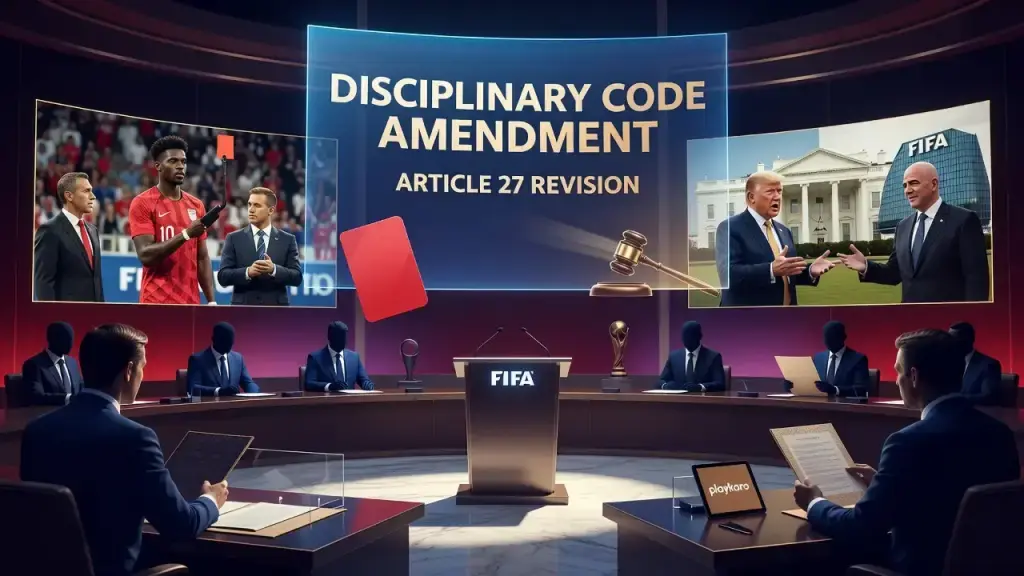
The proposed change targets Article 27 of FIFA's disciplinary code, the clause invoked to let Balogun play against Belgium, and would introduce "additional limits" to prevent automatic bans from being suspended in future tournaments.
Infantino's Position Looks More Secure
Despite the controversy, Infantino arrives at Thursday's meeting in a stronger political position than he held just months ago. Concacaf president Victor Montagliani opted against a leadership challenge, instead pursuing his own fourth term, while Paris Saint-Germain president Nasser Al-Khelaifi has also resisted calls to run. The Confederation of African Football gave Infantino its full backing last week, and he retains unanimous support across South America, with considerable backing in Oceania and Asia too. Asian Football Confederation president Sheikh Salman bin Ebrahim Al Khalifa, who questioned Infantino's leadership over the summer, has since proposed a working group to discuss reforms - a sign that, for now, consensus is being sought rather than confrontation.