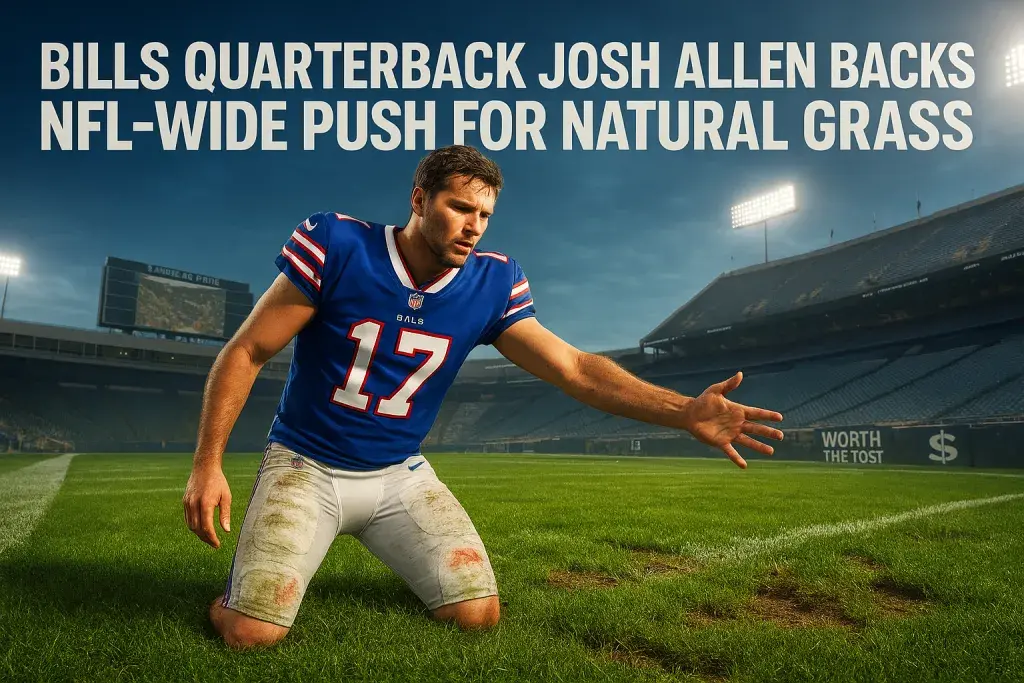
Bills Quarterback Josh Allen Backs NFL-Wide Push For Natural Grass
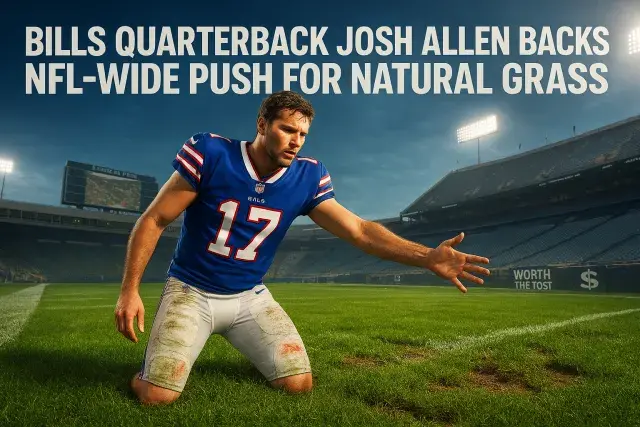
Josh Allen wants every NFL field covered in grass, and he is not alone. As the Buffalo Bills prepared for their first regular-season game at the new Highmark Stadium, the quarterback described chronic turf burns from artificial surfaces at the team's former facility, now demolished, that left him in pain even after practices on indoor turf at the fieldhouse.
"I've gotten numerous, numerous burns on my legs from artificial turf, to the point I can't sleep at night because it's bubbling over. It's very painful," Allen said. "If I could snap my fingers and make every field grass, that's what I would do for sure." His comments add a prominent voice to a long-running dispute between players and team owners over playing surfaces. The debate intensified after World Cup organizers required seven NFL stadiums to convert from turf to grass for soccer matches, only for those venues to switch back to artificial surfaces once football season began. 49ers defensive lineman Nick Bosa called the reversal "a little bizarre." サ野球 賭け
The NFL does not release cost figures, but artificial turf is widely understood to be cheaper than grass, which needs year-round upkeep and periodic resodding. Natural grass fields in NFL stadiums typically last about seven events, while artificial surfaces run between three and seven years with less-frequent infill replacement. Colts running back Jonathan Taylor pressed the point on social media, writing that "natural grass isn't out of reach" and using the hashtag "WorthTheCost." With Buffalo's new stadium, 16 of the NFL's 30 facilities now feature grass, including Lambeau Field in Green Bay, which combines natural turf with reinforcing synthetic fibers. Among the 18 NFL venues built since 2000, 11 use artificial surfaces - a list that does not include Carolina and Tennessee, which have since switched to turf. Cost and maintenance considerations appear to outweigh climate: six of the league's seven coldest markets, along with all three Florida-based teams, play on grass.
Surface technology has advanced considerably since the 1960s, when the Houston Oilers and other teams played on AstroTurf laid directly over concrete or asphalt. Nick Pappas, the NFL's director of field surfaces, said the league and NFL Players Association are now working with manufacturers to set uniform standards for both grass and artificial fields, covering impact absorption, traction and resurfacing timelines. Every team facility must meet those standards by 2028. Manufacturers must submit products for league testing and certification before installation - a shift from the previous system, in which teams selected surfaces largely based on vendor contracts. "The goal is that we take the emotions out of the material makeup," Pappas said. "What the composition of the field is should only be secondary to how the field performs." The NFL says its data show no significant difference in injury rates between grass and turf over the past three seasons, and that last season's lower-extremity injury rate was half the average recorded from 2018 to 2022.
Despite that data, several owners have opted for grass on safety grounds, including Raiders managing general partner Mark Davis, who installed natural turf in an indoor stadium in Las Vegas, and Bills owner Terry Pegula, who chose to wait for the new Highmark Stadium rather than convert the old facility. Buffalo's transition has not been seamless: despite heating coils, grow lights and ventilation systems installed to support the grass, divots and worn patches appeared after just two preseason games and two practices, prompting the team to resod the entire field ahead of schedule. The Bills resodded again after their final preseason game to allow more than three weeks of recovery before their home opener and are expected to resod at least once more before the season ends. Pappas, who inspected the field before and after Buffalo's preseason finale, called the process "trial and error" as the grass adapts to its new environment, adding that he expects continued improvement. Bills president Pete Guelli defended the added cost and effort. "I understand the economics of why people want an artificial turf field," he said. "But if you're really putting your players first, there's no other choice but grass."